Atlas grzybiarza. Najlepsze grzyby jadalne
ile jest grzybów jadalnych?

There are hundreds of species of edible fungi but only a few are worth eating. Others should be ignored for the table for various reasons. They may have no taste nor fine consistency, they may be too small or too rare or last but not least, they may have poisonous relatives which look pretty similar. You should also take into account that if you live in a part of the world far from Poland or with a different climate (e.g. southern Europe or the Mediterranean) there may be different poisonous look-alike species which are not known in Poland and not mentioned on this web site. In this case you should also check your local sources.
pierwsza liga
Ostrożni mogą ograniczyć się do zbierania grzybów rurkowych. W tej grupie, na szczęście, w Polsce nie występują gatunki niebezpiecznie trujące.
They do not need any special recommendation. They have a pleasant taste, are big and are common. When considering species with lamellae it is important to be very well aware of how to identify them because this group includes deadly poisonous species (in Poland there are no dangerously toxic mushrooms with pores).
Można przetwarzać, jak się komu podoba, ale z uwagi na cenę, najczęściej się go suszy i używa jako dodatku lub przyprawy.
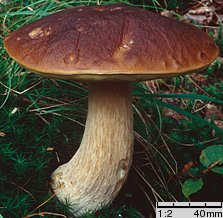
King Bolete, Cep, Porcini (Boletus edulis). Porcini. King Bolete. Certainly the most sought-after. Its main virtue is its superior aroma (especially when dried). The disadvantage is that it rarely grows in large quantities (one needs to know where to look). Can be preserved in every way. Most often dried and used as a spice to add its beautiful aroma to dishes.
Kurki przyjemnie się zbiera. Są też stosunkowo niezawodne. Pojawiają się co roku na początku lata i rosną nawet w czasie suchej pogody, gdy innych grzybów jeszcze brali
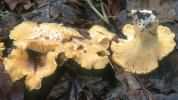
Chanterelle, Yellow Chanterelle (Cantharellus cibarius). Yellow Chanterelle. My favourite. Much more common than the King Bolete and easy to find. Its virtue is its pleasant aroma and taste. Should not be preserved because it loses its aroma.
Podobny gatunek czubajka gwiaździsta (Macrolepiota konradii) tworzy mniejsze owocniki, walory smakowe ma identyczne z czubajką kanią.
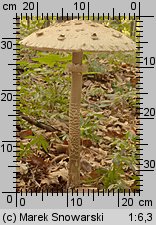
Parasol Mushroom (Macrolepiota procera). My favourite mushroom among gilled fungi. Its virtues are its pleasant aroma and taste, characteristic look and common occurrence. Most often pan-fried. In southern parts of Europe there is similar-looking poisonous Chlorophyllum molybdites. The closely related Shaggy Parasol (Macrolepiota rachodes) lacks aroma and in my opinion is not worth cooking. For more comments see pages on this species.
Natomiast najpospolitszy mleczaj świerkowy (Lactarius deterrimus) jest niestety najpodlejszym rydzem. A to z powodu dość gorzkiego smaku i braku specyficznego rydzowego smako-aromatu.
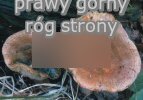
Lactarius deliciosus. The mushroom of choice for many, grows exclusively under pine. They are very tasty indeed. Traditionally, they are pan-fried in butter. There is a group of closely related species, among them Lactarius deterrimus which is associated with spruce trees. It lacks the pleasant taste and is somewhat bitter.
Inna dość często zbierana późnojesienna gąska, rosnąca w tych samych siedliskach to gąska niekształtna (Tricholoma portentosum).
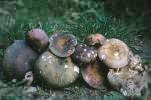
Man on Horseback (Tricholoma equestre). A favorite mushroom for many - it grows mainly in the late autumn on sandy soils under pines. Picking them is fun. They have a pleasant crunchy consistency. Another Tricholoma species often picked in the same habitat is Tricholoma portentosum.
Dobre, ale są lepsze
Good but there are better
Duże i często występują, ale ich jakość można kwestionować.
Big and common but of questionable quality.
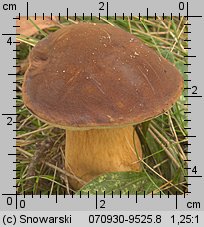
Xerocomus badius. Thanks to its abundance the most picked mushroom in Poland (after Yellow Chanterelle) . It does not have the strong aroma of King Bolete but is also tasty.
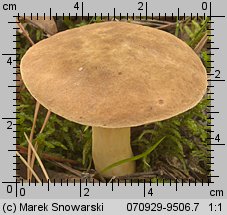
Xerocomus subtomentosus and Xerocomus chrysenteron. Other xerocomoid Boletes do not have a good reputation because of their soft flesh which is easily spoiled. But I like them when they are young mixed with other mushrooms or as a pickle.
Leccinum species with a red cap are picked most often for example Leccinum aurantiacum which grows under poplar or Leccinum versipelle under birches. Other species with a brown cap, like the Birch Bolete (Leccinum scabrum) common under birches and Leccinum carpini may be considered. The stems should be discarded as they are woody.
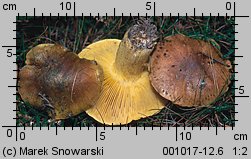
Suillus are often picked. The best are the brown and sticky Slippery Jack (Suillus luteus), found under pines, the yellow-orange and sticky Suillus grevillei under larches and the dry-capped Suillus variegatus. The sticky cap makes it hard to clean them for cooking.
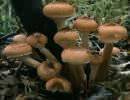
Armillaria mellea sensu lato. Very common. Grows clustered in large quantities, is so abundant that picking them is more like hard work then like hunting.
Dobre ale rzadko zbierane
Good but rarely collected
Duże, smaczne i przeważnie dość pospolite. Są rzadko zbierane lub jedynie regionalnie z braku tradycji i wiedzy na ich temat. Od nowicjuszy wymagają dobrej znajomości danego gatunku.
Big, tasty and usually quite common. Rarely picked or only regionally because there is no tradition of doing so. Novices should know about their characteristics.
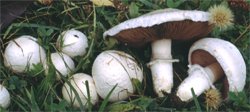
AgaricusThey are tasty. In Poland, the white Agarics growing on pastures are picked, usually the Field Mushroom, Meadow Mushroom (Agaricus campestris) or Horse Mushroom (Agaricus arvensis). One should know that there are almost a hundred species of Agaricus. Among them are toxic ones (which cause stomach upsets). Toxic ones usually bruise yellow on the cap and stem surface and have unpleasant phenol-like smell.
Gołąbki są ciekawym pomysłem na danie grzybowe (np. do zupy) ale są jednak rzadko zbierane.
Most highly recommended is the big Russula cyanoxantha and related species with compact flesh. One must have perfect knowledge about deadly poisonous Death Cap (Amanita phalloides) — there is no place left for ignorance.
Other Russula with mild flesh can also be eaten. Mild flesh rule is valid only for Russula. They are good for cooking but they are rarely picked in Poland.
Lokalnie w Polsce często zbierany. Rośnie także w pełni lata. Problemem jest to, że większość egzemplarzy jest opanowana przez larwy owadów.
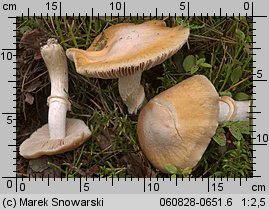
Gypsy Mushroom, Chicken of the woods (Rozites caperatus) is large mushroom. Often grows in large quantities in pine forests. Tasty. Locally picked in Poland.
Jew's Ears (Hirneola auricula-judae). This species (or cultivated forms) are common ingredients in many Chinese dishes. They can be seen in there as brown stripes of gristly consistency.
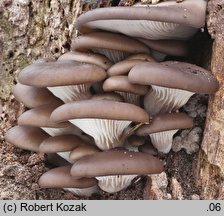
Oyster Mushroom (Pleurotus ostreatus). This species is often cultivated. Some say that wild ones are more tasty but I doubt it.
wersja publikacji 26.03.2013.www · ostatnio zmieniana/last modified 28.08.2011 · została utworzona/was created 02.08.2000
<a href="http://www.grzyby.pl/najlepsze-grzyby-jadalne.htm">Atlas grzybiarza. Najlepsze grzyby jadalne - Grzyby Polski, Fungi of Poland grzyby.pl</a>