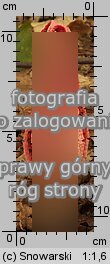
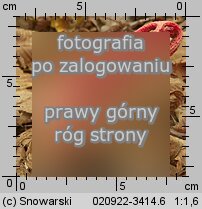
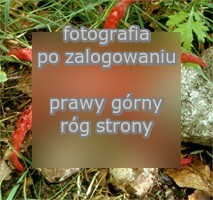
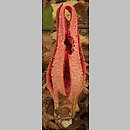
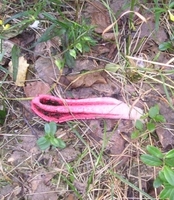
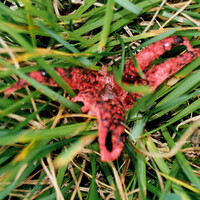
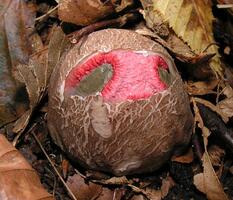
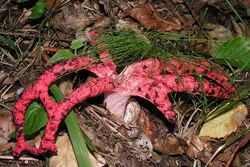
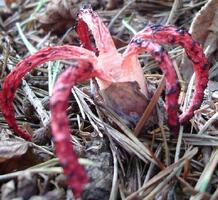
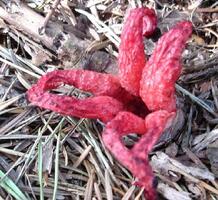
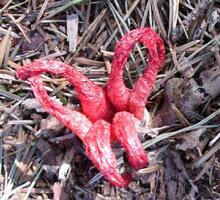
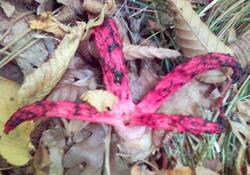
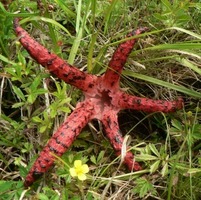
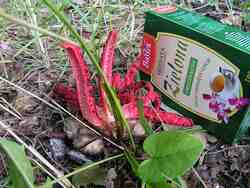
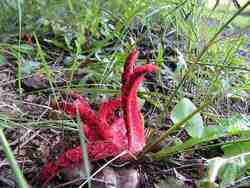
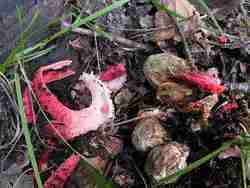
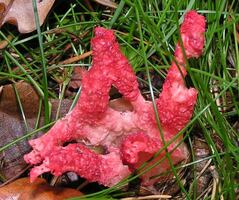
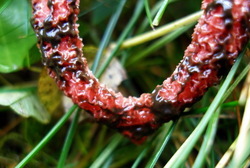
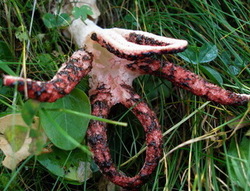
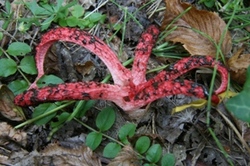
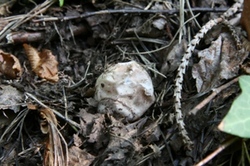
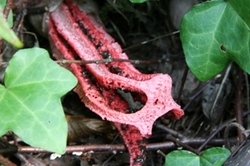
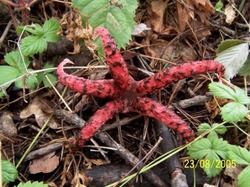
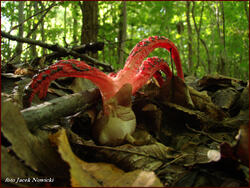
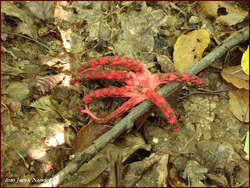
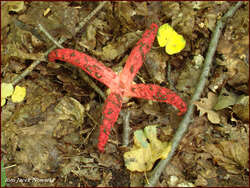
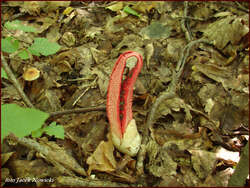
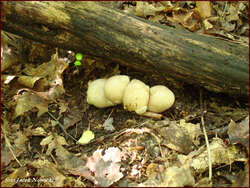
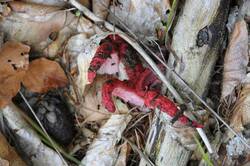
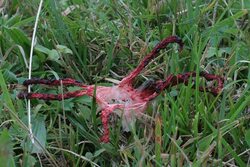
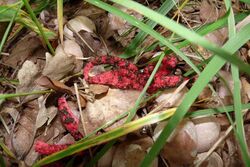
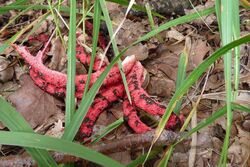
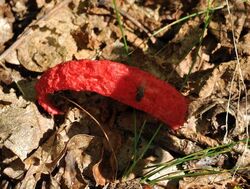
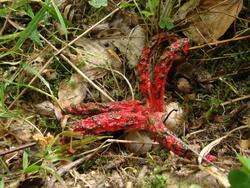
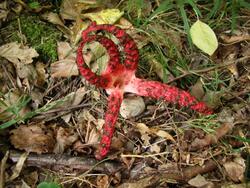
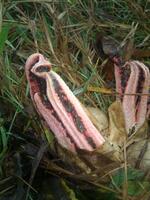
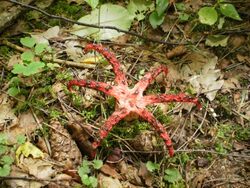
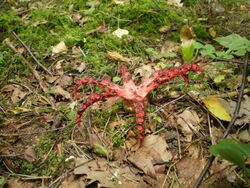
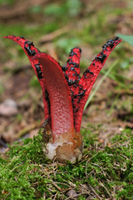
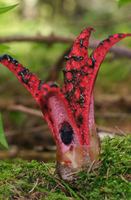
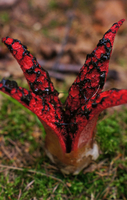
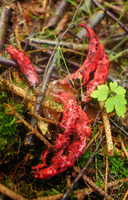
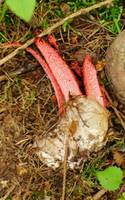
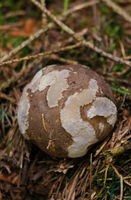
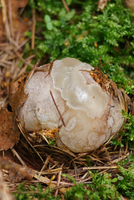
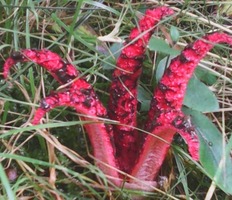
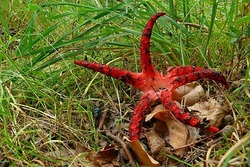
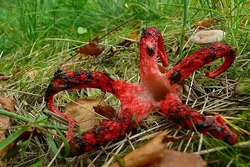
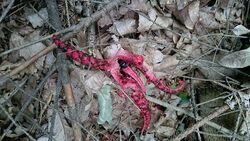
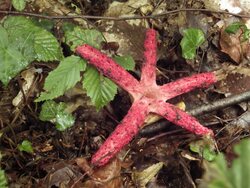
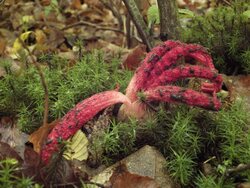
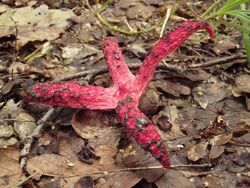
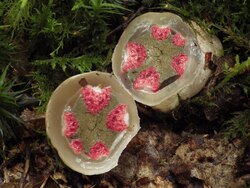
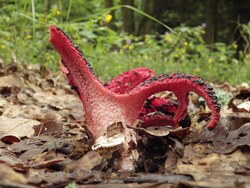
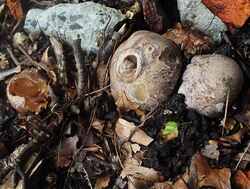
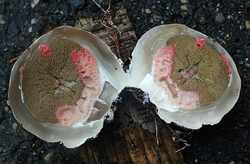
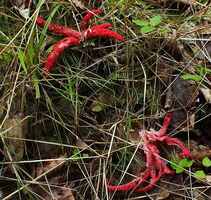
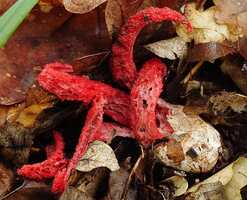
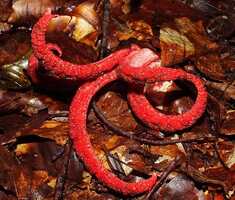
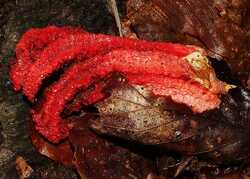
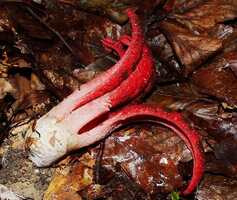
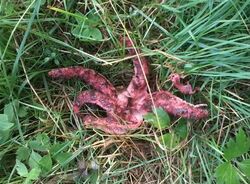
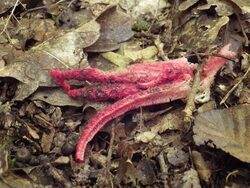
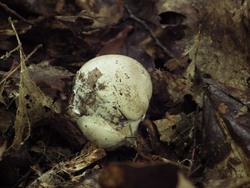
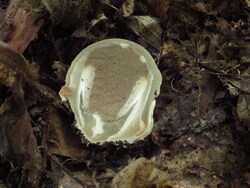
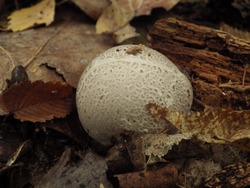
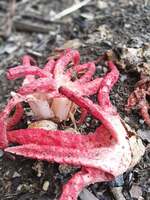
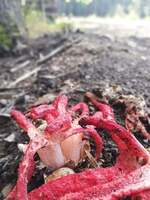
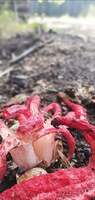
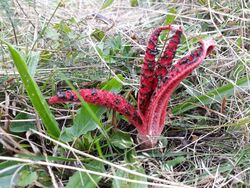
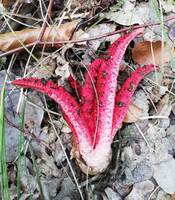
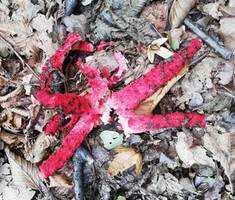
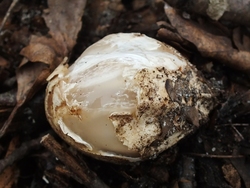
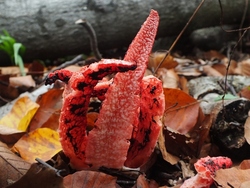
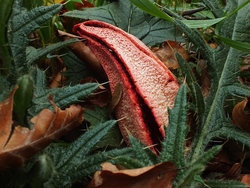
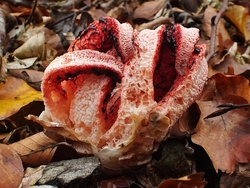
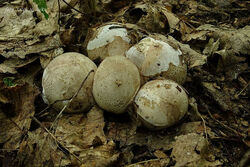
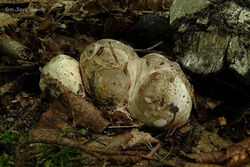
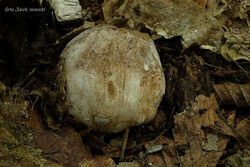
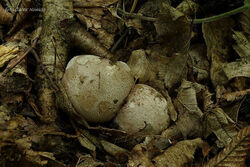
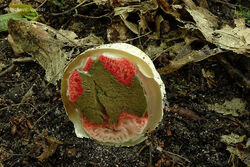
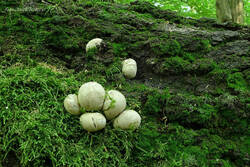
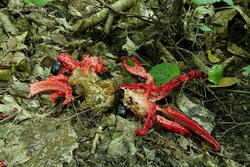
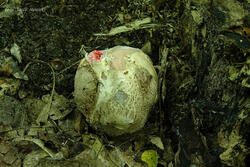
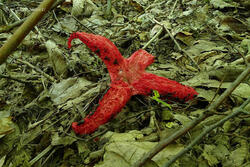
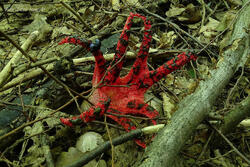
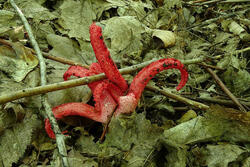
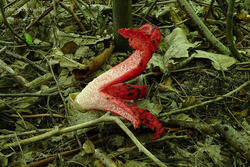
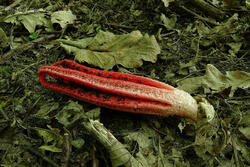
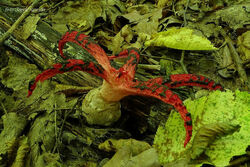
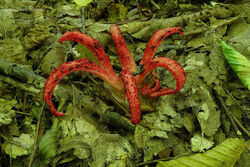
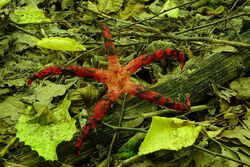
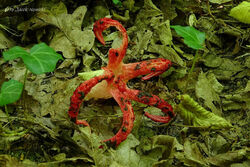
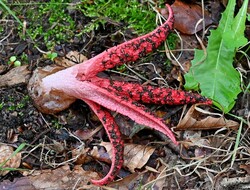
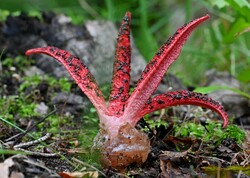
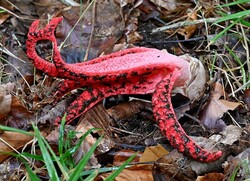
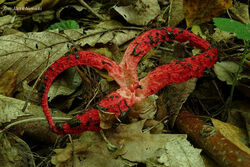
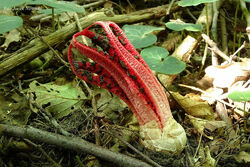
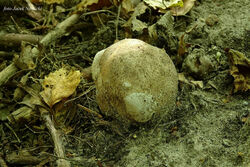
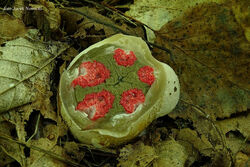
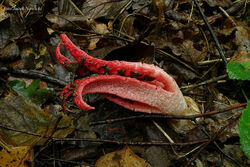
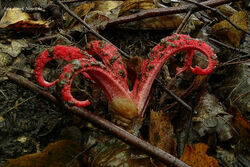
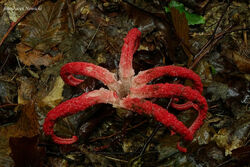
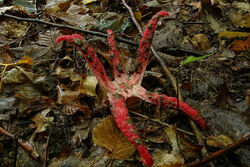
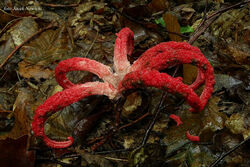
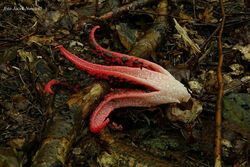
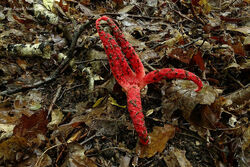
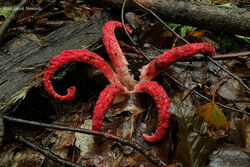
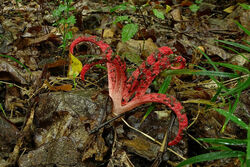
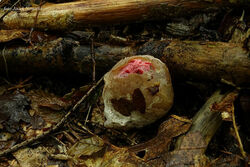
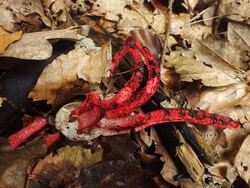
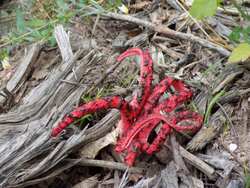
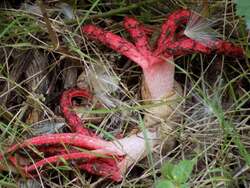
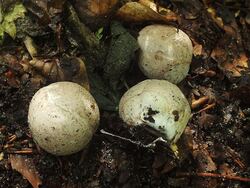
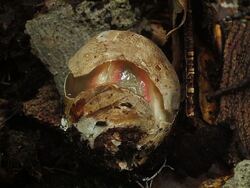
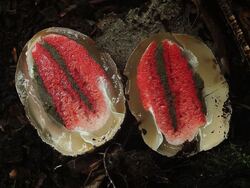
Młode owocniki w formie kulistej lub jajowatej, z bruzdami odpowiadającymi ułożeniu ramion, średnicy 25-45(60) mm, białawe do jasnożółtych, często z fioletowym nalotem, zagrzebane w podłożu lub nieco wystające.
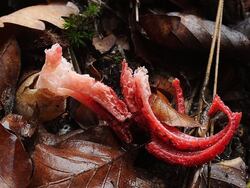
Dojrzały owocnik wydziela wyjątkowo intensywny i nieprzyjemny zapach zwabiający muchy padlinożerne, które przyczyniają się do roznoszenia zarodników.
zarodniki
Zarodniki wąskoelipsoidalne, hialinowe, 4-7.5 x 2-2.5 µm.
Spores cylindric-ellipsoid, hyaline, 4-7.5 x 2-2.5 µm.
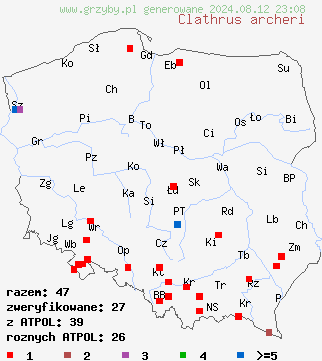
Coraz częstszy na terenie całej Polski. Gatunek ten pochodzi z Australii i rozprzestrzenia się w Europie.
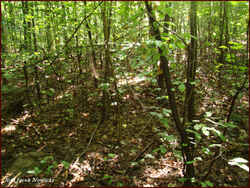
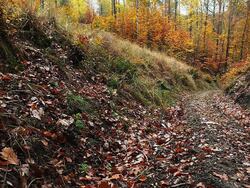
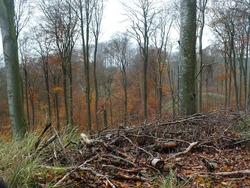
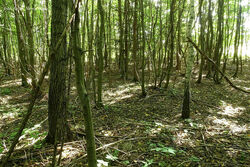
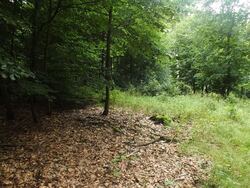
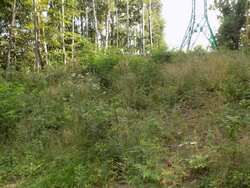
Owocniki wyrastają w miejscach bogatych w materię organiczną, rozłożone drewno, w lasach i poza nimi, w zaroślach, w sadach, na glebach różnego typu, także kwaśnych.
More and more frequent all over Poland. This species comes from Australia. Sporocarps grow in places rich in organic matter, decomposed wood.
uwagi
W Europie po raz pierwszy obserwowany w 1914 roku we Francji i stopniowo rozszerzający się po całej Europie. Znam osobiście dwa stanowiska na Dolnym Śląsku, jedno w okolicy Międzygórza (Masyw Śnieżnika) na łące, drugie we Wrocławiu, w Dolinie Bystrzycy w lesie grabowym.
Anonim (2017)[1289]Anonim (2017) Ośmiornica? Rozgwiazda? Nie, to grzyb. Nowiny Gminne. Miesięcznik Gminy Rudna 10 (198): 2[1289], Bartoszek & Mleczko (2019)[1301]Bartoszek & Mleczko (2019) Przyroda Gorczańskiego Parku Narodowego.[1301], Beczała et al. (2011)[1303]Beczała et al. (2011) Nowe stanowiska okratka australijskiego w Beskidzie Śląskim.[1303], Boruszewska & Chmilewska (2005)[1327]Boruszewska & Chmilewska (2005) Na stoku Suchej Góry w Rajczy. Osobliwy grzyb.[1327], Chachuła et al. (2021)[1375]Chachuła et al. (2021) Materiały do poznania różnorodności grzybów wielkoowocnikowych Ustronia w województwie Śląskim.[1375], Chlebicki (1997)[2663]Chlebicki (1997) Nowe stanowiska smardzówki czeskiej Verpa bohemica, okratka australijskiego Clathrus archeri i czasznicy olbrzymiej Calvatia gigantea na Dolnym Śląsku.[2663], Demidowska (1998)[2672]Demidowska (1998) Okratek australijski (Clathrus archeri).[2672], Domian (2010)[1418]Domian (2010) Grzyby inwazyjne.[1418], Flisińska (2004)[1452]Flisińska (2004) Grzyby Lubelszczyzny. Wielkoowocnikowe podstawczaki (Basidiomycetes). 2. Lubelskie Towarzystwo Naukowe[1452] (as: Anthurus archeri), Gierczyk et al. (2009)[1482]Gierczyk et al. (2009) Grzyby wielkoowocnikowe Polskich Bieszczadów. Część I.[1482], Gierczyk et al. (2018)[1501]Gierczyk et al. (2018) Contribution to the knowledge of mycobiota of the Western Sudety Mountains and Western Sudety Foothills (SW Poland). Part 1.[1501], Gierczyk et al. (2019)[1495]Gierczyk et al. (2019) Macrofungi of the Bieszczady Mountains.[1495], Halama et al. (2010)[1564]Halama et al. (2010) Nowe stanowiska Clathrus archeri (Berk.) Dring (Basidiomycota, Phallales) na Dolnym Śląsku.[1564], Jakubska (2006)[1601]Jakubska (2006) Nowe stanowisko okratka australijskiego Clathrus archeri (Berk.) Dring na Przedgórzu Sudeckim.[1601], Kierasiński (1992)[2900]Kierasiński (1992) Okratek australijski.[2900], Kozik i Nabożny (1997)[1703]Kozik i Nabożny (1997) Nowe stanowiska okratka australijskiego Clathrus archeri (Berk.) Dring. w Tarnowie i okolicy.[1703], Kozłowska et al. (2019)[1706]Kozłowska et al. (2019) An annotated catalogue of the fungal biota of the Roztocze Upland. Richness, diversity and distribution.[1706], Kujawa (2005)[1750]Kujawa (2005) "Rejestr gatunków grzybów chronionych i zagrożonych" - nowa forma gromadzenia danych mikologicznych pochodzących od amatorów. Podsumowanie roku 2005.[1750], Kujawa & Gierczyk (2007)[1769]Kujawa & Gierczyk (2007) Rejestr gatunków grzybów chronionych i zagrożonych. Część II. Podsumowanie roku 2006.[1769], Kujawa & Gierczyk (2011)[1771]Kujawa & Gierczyk (2011) Rejestr gatunków grzybów chronionych i zagrożonych w Polsce. Część IV. Wykaz gatunków przyjętych do rejestru w roku 2008.[1771], Kujawa & Gierczyk (2012)[1773]Kujawa & Gierczyk (2012) Rejestr gatunków grzybów chronionych i zagrożonych w Polsce. Część VI. Wykaz gatunków przyjętych do rejestru w roku 2010.[1773], Kujawa & Gierczyk (2013)[1774]Kujawa & Gierczyk (2013) Rejestr gatunków grzybów chronionych i zagrożonych w Polsce. Część VII. Wykaz gatunków przyjętych do rejestru w roku 2011.[1774], Kujawa & Gierczyk (2013)[1775]Kujawa & Gierczyk (2013) Rejestr gatunków grzybów chronionych i zagrożonych w Polsce. Część VIII. Wykaz gatunków przyjętych do rejestru w roku 2012.[1775], Kujawa & Gierczyk (2016)[1776]Kujawa & Gierczyk (2016) Rejestr gatunków grzybów chronionych i zagrożonych w Polsce. Część IX. Wykaz gatunków przyjętych do rejestru w roku 2013.[1776], Leski i (Pietras?) (2010)[1825]Leski i (Pietras?) (2010) Osobliwy okratek. Las Polski 11 str. 16[1825], Łuszczyński (2000)[1883]Łuszczyński (2000) Grzyby wielkoowocnikowe.[1883], Łuszczyński (2004c)[1893]Łuszczyński (2004c) Przemiany grzybów macromycetes w Górach Świętokrzyskich w okresie ostatnich 100 lat. W: Jendrzejczak E. (red.). Przyroda Polski w europejskim dziedzictwie dóbr natury. Streszczenia referatów i plakatów. 53 Zjazd Polskiego Towarzystwa Botanicznego, Toruń-Bydgoszcz, 6-11 września 2004: 136[1893] (as: Anthurus archeri), Łuszczyński (2007)[1896]Łuszczyński (2007) Diversity of Basidiomycetes in various ecosystems of the Góry Świętokrzyskie Mts.[1896], Łuszczyński (2008)[1898]Łuszczyński (2008) Basidiomycetes of the Góry Świętokrzyskie Mts. A checklist.[1898], Łuszczyński & Świercz (2004)[1923]Łuszczyński & Świercz (2004) Kwiatowiec australijski Anthurus archeri (Berk.) E. Fisch. w Świętokrzyskim Parku Narodowym.[1923] (as: Anthurus archeri), Markowska (2004)[1941]Markowska (2004) Stan, zagrożenia i ochrona grzybów wielkoowocnikowych województwa opolskiego. W: Nowak A., Spałek K. (red.). Ochrona szaty roślinnej Śląska Opolskiego. Uniwersytet Opolski, Opole: 185-198[1941], Miądlikowska (1995)[3011]Miądlikowska (1995) New locality of Clathrus archeri in Poland.[3011], Michalec (2001)[3820]Michalec (2001) Okratek – ciekawostka biologiczna. Australia w Polsce.[3820], Mirek i in. (2014)[1951]Mirek i in. (2014) Okratek australijski na Brzanówce. Tatry 50, 4: 47[1951], Nabożny et al. (1998)[3025]Nabożny et al. (1998) Ciężkowicko-Rożnowski Park Krajobrazowy.[3025], Narkiewicz (2011)[1997]Narkiewicz (2011) Sprawozdanie z XXI wystawy świeżych grzybów w Jeleniej Górze.[1997], Narkiewicz (2019)[2003]Narkiewicz (2019) Grzyby i śluzowce.[2003], Narkiewicz et al. (2013)[2002]Narkiewicz et al. (2013) Grzyby i śluzowce.[2002], Nowak (1989)[3062]Nowak (1989) Uwaga grzybiarze - kto jeszcze zauważył?.[3062], Nowak & Spałek (2001)[2016]Nowak & Spałek (2001) Materials to the distribution of rare and interesting macrofungi in the Opole Silesia.[2016], Pietras (2020)[2077]Pietras (2020) Czas na klimat. Wędrówki grzybów. Głos Lasu 7-8: 26-28[2077], Pietras et al. (2016)[2087]Pietras et al. (2016) Distribution and molecular characterization of an alien fungus, Clathrus archeri, in Poland.[2087], Pietras et al. (2016)[2079]Pietras et al. (2016) Grzyby wielkoowocnikowe.[2079], Pietras i in. (2011)[2078]Pietras i in. (2011) The ectomycorrhizal fungi in decling pedunculate oak Quercus robur stands.W: Diamandis S., Topalidou E. (eds.). XVI Congress of European Mycologists, N. Marmaras, Halkidiki, Greece September 18-23, 2011. Abstracts. NAGREF-FOREST Research Institute Vassilika, Thessaloniki Greece: 233-234[2078], Piętka et al. (2021)[2095]Piętka et al. (2021) Octopus stinkhorn Clathrus archeri (Berk.) Dring, an alien stinkhorn fungus (Phallaceae), in north-eastern Poland.[2095], Przewoźnik (2015)[1727]Przewoźnik (2015) Działania podejmowane w Karkonoskim Parku Narodowym w celu zwalczania lub ograniczenia rozprzestrzeniania się gatunków obcych.[1727], Rudnicka-Jezierska (1991)[1065]Rudnicka-Jezierska (1991) Grzyby (Mycota). Tom 23. Podstawczaki (Basidiomycota). Purchawkowe (Lycoperdales), tęgoskórowe (Sclerodermatales), pałeczkowe (Tulostomatales), gniazdnicowe (Nidulariales), sromotnikowe (Phallales), osiatkowe (Podaxales).[1065], Sałata (1977)[3176]Sałata (1977) Dwa nowe dla flory Polski gatunki grzybów wyższych.[3176], Sałata & Jakubowska (1987)[3180]Sałata & Jakubowska (1987) Stanowisko grzyba okratka australijskiego Clathrus archeri w Polsce.[3180], Stebel (2015)[2262]Stebel (2015) Occurrence of the fungus Clathrus archeri (Phallaceae) in the Rożnowskie Foothills (Western Carpathians, Poland).[2262], Stengl-Rejthar & Wojewoda (1985)[3250]Stengl-Rejthar & Wojewoda (1985) Expansion of the fungus Clathrus archeri (Berk.) Dring (Gasteromycetes) in Europe and Poland.[3250], Stój (1992)[3257]Stój (1992) Okratek australijski (Świątkowa Wielka, gmina Krępna), projektowany Magurski Park Narodowy.[3257], Szczepańska (2004)[2287]Szczepańska (2004) Nowe stanowisko Clathrus archeri (Berk.) Dring (Basidiomycetes, Phallales) na Dolnym Śląsku.[2287], Szczepkowski & Obidziński (2012)[2350]Szczepkowski & Obidziński (2012) Obce gatunki sromotnikowatych Phallaceae w lasach Polski.[2350], Szczęśniak & Szopińska (2022)[2362]Szczęśniak & Szopińska (2022) Nowe stanowisko okratka australijskiego Clathrus archeri (Berk.) Dring w parku zamku Książ (Pogórze Wałbrzyskie).[2362], Szewczyk (2019)[2364]Szewczyk (2019) Przyroda gminy Oborniki Śląskie.[2364], Świercz (2004)[2402]Świercz (2004) Okratek australijski (Clathrus archeri) w Świętokrzyskim Parku Narodowym. Parki Narodowe 4: 25-26[2402], Świerkosz et al. (2018)[2408]Świerkosz et al. (2018) Nowe stanowiska grzybów makroskopijnych w Sudetach i na ich Przedgórzu.[2408], Tomasiewicz (1992)[3306]Tomasiewicz (1992) Stanowisko okratka australijskiego Clathrus archeri w Polsce.[3306], Trzeciak (2000)[2418]Trzeciak (2000) Stanowiska chronionych i rzadkich gatunków grzybów w Ciężkowicko-Rożnowskim Parku Krajobrazowym.[2418], Tuła (1995)[3310]Tuła (1995) Okratek australijski (Clathrus archeri).[3310], Wartecki (2002)[3333]Wartecki (2002) Okratek australijski.[3333], Wilczek (2016)[2429]Wilczek (2016) Ścieżka przyrodniczo-dydaktyczna w Lasku Wilkowickim.[2429], Wojewoda (2003)[1146]Wojewoda (2003) Checklist of Polish larger Basidiomycetes.[1146], Wojewoda & Karasiński (2010)[2539]Wojewoda & Karasiński (2010) Invasive macrofungi (Ascomycota and Basidiomycota) in Poland.[2539], Wojewoda & Wojewoda (2007)[2543]Wojewoda & Wojewoda (2007) Grzyby inwazyjne: okratek australijski Clathrus archeri i pierścieniak uprawny Stropharia rugosoannulata w Beskidzie Wyspowym.[2543], Wojewoda et al. (2016)[2542]Wojewoda et al. (2016) Grzyby makroskopijne Gorców (Karpaty Zachodnie).[2542], Żurawlew (2023)[3755]Żurawlew (2023) Stanowiska okratka australijskiego Clathrus archeri (Berk.) Dring (Phallaceae, Basidiomycota) w okolicach Pleszewa (Wielkopolska).[3755]
w rejestrze grzybów chronionych i zagrożonych GRej
ID na żółtym tle to oznaczenie zweryfikowane przez kustosza GRej, pozostałe oczekują na weryfikację.
Fotografie oznaczone [z wątku] są automatycznie pobrane z wątku bio-forum.pl wskazanego we wpisie; aby upewnić się które odnoszą się do wpisu, należy zajrzeć do wątku.
ID 16 276
oznaczenie: Clathrus archeri;
lokalizacja: Kłodzko, BF26; data zbioru: 14 lip 2005;
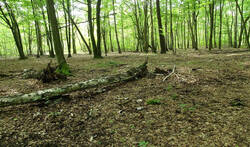
sielisko, podłoże, sposób wzrostu: Prześwietlone miejsce przy brzegu lasu sosna+dąb+buk+brzoza, wśród liści i traw, kilka owocników wzdłóż brzegu lasu w lesie;
leg. Piotr Perz, det. Piotr Perz + Anna Kujawa; eksykat: tak; uwagi: cuchnie nieziemsko :! [notatka: tak] [fotografie: tak]; publikacja: Kujawa 2005. "Rejestr gatunków grzybów chronionych i zagrożonych" - nowa forma gromadzenia danych mikologicznych pochodzących od amatorów. Podsumowanie roku 2005. Przegl. Przyr. 16 (3-4): 17-52;
ID 20 073
oznaczenie: Clathrus archeri;
lokalizacja: Las Bukownica (Puszcza Solska), gm. Hedwiżyn obok Biłgoraja, GF00; data zbioru: 4 wrz 2005;
sielisko, podłoże, sposób wzrostu: Puszcza sosnowa, w pobliżu kilka grabów, Bezpośrednio na ziemi miedzy jagodziankami i borówkami, pojedyńczy owocnik;
leg. Elmira Brzozowska, det. Marcin Piątek; uwagi: fot.17819 [notatka: nie] [fotografie: Tak - cyfrowe i na papierze fotograficznym]; publikacja: Kujawa 2005. "Rejestr gatunków grzybów chronionych i zagrożonych" - nowa forma gromadzenia danych mikologicznych pochodzących od amatorów. Podsumowanie roku 2005. Przegl. Przyr. 16 (3-4): 17-52;
17819
ID 22 544
oznaczenie: Clathrus archeri;
lokalizacja: Wetlina w Bieszczadach. Na południe od miejscowości. Na łące w pobliżu lasu mieszanego., FG68; data zbioru: 24 kwi 2005;
sielisko, podłoże, sposób wzrostu: Pastwisko przy lesie mieszanym, na ziemi, pojedynczo;
leg. Wawrzyniec Iwański, Przemysław Dębicki, Robert Denst, det. Arkadiusz Stępień; uwagi: fot.21647 [notatka: nie] [fotografie: tak]; publikacja: Kujawa 2005.;
21647
ID 44 507
oznaczenie: Clathrus archeri;
lokalizacja: Przy drodze z Sobótki do Sulistrowic, ~200 m na prawo w górę od skrzyżowania z drogą do Sulistrzowiczek, BE77; data zbioru: 24 wrz 2006;
sielisko, podłoże, sposób wzrostu: Las dębowo sosnowy i czeremcha gdzieniegdzie, poszycie konwalie i jeżyny, na ściółce leśnej, dośc suchej ale też jeden okaz w trawie przy starej plancji porzeczek na ciężkiej gliniastej glebie, cztery okazy rosnące w promieniu 5 metrów;
leg. det. Włodzimierz Kita; uwagi: Mimo że od ponad tzrydziestu lat zajmuję sie grzybami nie widziałem jeszcze tego gatunku na żywo. [notatka: nie] [fotografie: Fotografii zrobiłem okło trzydziestu w różnych ujęciach i oświetleniu. [bf:63431]]; publikacja: Kujawa A., Gierczyk B. 2007. Rejestr gatunków grzybów chronionych i zagrożonych. Część II. Wykaz gatunków przyjętych do rejestru w roku 2006. Przegląd Przyrodniczy 18(3-4): 3-70;
związane wątki bio-forum.pl:63431;
ID 45 343
oznaczenie: Clathrus archeri;
lokalizacja: Puszcza Bukowa, pow. Gryfino, 1,4 km na NW od Dobropola, AB94; data zbioru: 26 wrz 2006;
sielisko, podłoże, sposób wzrostu: drzewostan grabowo-bukowy w dolinie strumienia, na dwóch stanowiskach rozdzielonych leśną drogą utwardzoną gruzem, na ziemi, masowo, na powierzchni około 300 m2 conajmniej 120 owocników w róznych stadiach rozwojowych;
leg. Grazyna Domian, det. Marzena Łyczek, Grażyna Domian; eksykat: TAK (u Marzeny Łyczek); uwagi: fot.58410 fot.58411 [notatka: tak] [fotografie: tak]; publikacja: Kujawa A., Gierczyk B. 2007. Rejestr gatunków grzybów chronionych i zagrożonych. Część II. Wykaz gatunków przyjętych do rejestru w roku 2006. Przegląd Przyrodniczy 18(3-4): 3-70;
58410
58411
ID 45 775
oznaczenie: Clathrus archeri;
lokalizacja: Huta Polańska, powiat jasielski, FG31; data zbioru: 25 wrz 2006;
sielisko, podłoże, sposób wzrostu: las mieszany (jodła, leszczyna i in.), na ziemi, na ciepłym, nasłonecznionym stku, 2 owocniki blisko siebie;
leg. det. Anna Hreczka; eksykat: Tak, w Stacji ZBŚRiL PAN, 6/AH/6.09.10; uwagi: fot.59077 fot.59078 fot.59079 [notatka: nie] [fotografie: tak]; publikacja: Kujawa A., Gierczyk B. 2012. Rejestr gatunków grzybów chronionych i zagrożonych w Polsce. Część VI. Wykaz gatunków przyjętych do rejestru w roku 2010. Przegląd Przyrodniczy 23(2): 3-59;
59077
59078
59079
ID 46 421
oznaczenie: Clathrus archeri;
lokalizacja: Budy Głogowskie - Podkarpacie, FF53; data zbioru: 8 paź 2006;
sielisko, podłoże, sposób wzrostu: las bukowo-dębowy, liściaste, pojedyncze;
leg. det. Piotr Stopa; eksykat: TAK, w Stacji ZBŚRiL PAN, 1/PS/22.10.06; uwagi: Witam! Znalazłem Okratka Australijskiego dzisiaj w lesie tj. 2006-10-08 w Budach Głogowskich na Podkarpaciu niedaleko Rzeszowa. Dwa lata temu spotykałem pojedyncze sztuki, a teraz jest ich coraz więcej.; fot.60154; publikacja: Kujawa A., Gierczyk B. 2007. Rejestr gatunków grzybów chronionych i zagrożonych. Część II. Wykaz gatunków przyjętych do rejestru w roku 2006. Przegląd Przyrodniczy 18(3-4): 3-70;
60154
ID 80 964
oznaczenie: Clathrus archeri;
lokalizacja: Ochotnica Górna, Powiat Nowy Targ, EG22; data zbioru: 14 lip 2007;
sielisko, podłoże, sposób wzrostu: łąka bliźniczkowa, na glebie, 3 osobniki w grupie;
leg. det. Marek Ruciński; eksykat: nie; uwagi: fot.129411; Sucha łąka bliźniczkowa użytkowana ekstensywnie pastersko, na skraju boru jodłowo-świerkowego.; Południowo-zachodnia ekspozycja stoku. [notatka: tak] [fotografie: tak];
129411
ID 109 932
oznaczenie: Clathrus archeri;
lokalizacja: Nieborowice las, DF33; data zbioru: 20 sie 2008;
sielisko, podłoże, sposób wzrostu: las z przewagą dębu, na ziemi wśród kory, pod dębami w miejscu zacienionym, przy wielkiej kałuży., kilkadziesiąt owocników zgrupowanych, pozrastanych nawet i po trzy, w sumie na 3 metrach około 30 owocników;
leg. det. Jolanta Kozak; eksykat: TAK, w Stacji ZBŚRiL PAN, 9/JK/9.05.09; uwagi: fot.191179 fot.191180 fot.191181 [fotografie: tak]; publikacja: Kujawa A., Gierczyk B. 2011. Rejestr gatunków grzybów chronionych i zagrożonych w Polsce. Część IV. Wykaz gatunków przyjętych do rejestru w roku 2008. Przegląd Przyrodniczy 22(1): 17-83;
191179
191180
191181
ID 111 715
oznaczenie: Clathrus archeri;
lokalizacja: Puszcza Bukowa, 2,5km na N od Chlebowa, gm. Stare Czarnowo, pow. Gryfino, zachodniopomorskie, AB93; data zbioru: 18 paź 2007;
sielisko, podłoże, sposób wzrostu: dąbrowa z domieszką starych sosen na terenie powojskowym, na ziemi, pojedynczo;
leg. det. Grazyna Domian; eksykat: NIE (problem z suszeniem;); uwagi: okratek australijski; fot.195240 [notatka: tak] [fotografie: tak];
195240
ID 117 835
oznaczenie: Clathrus archeri;
lokalizacja: Lipowa k/ Żywca, DG03; data zbioru: 12 paź 2008;
sielisko, podłoże, sposób wzrostu: Pastwisko / łąka podleśna, wśród traw, pojedyńczy osobnik;
leg. Grzegorz Wereszczyński, det. Grzegorz "Rapatang"; eksykat: nie; uwagi: nigdzie nie było widac ani innych jaj, ani nawet szczątkowych innych osobników; fot.208698 fot.208699 [notatka: tak] [fotografie: tak];
208698
208699
ID 143 814
oznaczenie: Clathrus archeri;
lokalizacja: Mirzec, pow. Starachowicki, Świętokrzyskie; data zbioru: 5 wrz 2009;
sielisko, podłoże, sposób wzrostu: Łąka, blisko zabudowań w dawnym miejscu składowania drewna , na obszarze 2ha, W trawie między korą i sarym drewnem., W dużych grupach, oddalonych od siebie o kilkadziesiąt metrów, na dużym obszarze, nie możliwe do dokładnego policzenia około 40-60 sztuk;
leg. det. Bartłomiej Koniarz; eksykat: Prawem chroniony; uwagi: Rośnie w bezpośrednim sąsiedztwie, Mądziaka psiego Mutinus caninus!, występującego tu w mniejszej ilości. [notatka: nie] [fotografie: tak];
ID 146 498
oznaczenie: Clathrus archeri;
lokalizacja: Nowe Rybie (powiat limanowski, woj. małopolskie), EF92; data zbioru: 23 wrz 2009;
sielisko, podłoże, sposób wzrostu: osiki, brzozy, jodły, na ziemi, w grupie - około 5-7 osobników na 1 m^2, niespełna 10 m od tego miejsca 1 osobnik;
leg. det. Mariusz Łapczyński; uwagi: odwiedzam to miejsce regularnie od kilkunastu lat i nigdy nie spotkałem tego gatunku; fot.277304 fot.277305 fot.277306 [fotografie: tak];
277304
277305
277306
ID 160 260
oznaczenie: Clathrus archeri;
lokalizacja: kamieniołom magnezytu na g. Bukowczyk, pow. Grochowa, woj. dolnośląskie, BF17; data zbioru: 23 sie 2005;
sielisko, podłoże, sposób wzrostu: przy brzegu lasu, pod sosną (potencjalnie grądowe), , w grupie 5-6 owocników;
leg. det. Piotr Kosiński; uwagi: fot.318978 [notatka: TAK, 168/05] [fotografie: tak];
318978
ID 189 978
oznaczenie: Clathrus archeri;
lokalizacja: 1 km W, Kotków, gm.Gorzkowice, pow. piotrkowski, woj. łódzkie, DE47; data zbioru: 14 sie 2011;
sielisko, podłoże, sposób wzrostu: las liściasty, w zaroślach, na ziemi, grupa ponad 25 owocników, większość w stadium ''jaj'';
leg. det. Jacek Nowicki; eksykat: Tak, w Stacji ZBŚRiL PAN, 6/JN/5.10.11; uwagi: 51 10 7 N ; 19 35 29 E; fot.437519 fot.437520 fot.437521 fot.437522 fot.437523; siedlisko; fot.437524 [notatka: nie] [fotografie: tak]; publikacja: Kujawa A., Gierczyk B. 2013. Rejestr gatunków grzybów chronionych i zagrożonych w Polsce. Część VII. Wykaz gatunków przyjętych do rejestru w roku 2011. Przegląd Przyrodniczy 24(2): 3-44;
437519
437520
437521
437522
437523
437524
ID 201 311
oznaczenie: Clathrus archeri;
lokalizacja: 2km E Modliszów, wys. 450m n.p.m., pow. świdnicki, woj. dolnośląskie; data zbioru: 22 lip 2012;
sielisko, podłoże, sposób wzrostu: świerczyna, przy leśnej drodze, na ziemi, wśród suchych liści i igieł, w grupie, 3;
leg. det. Radosław Grochowski; uwagi: trzy owocniki oddalone były od siebie o kilka do kilkunastu metrów. fot.500659 [fotografie: tak];
500659
ID 202 677
oznaczenie: Clathrus archeri;
lokalizacja: Buków, gm. Mogilny, pow. krakowski, woj. małopolskie, DF79; data zbioru: 12 sie 2012;
sielisko, podłoże, sposób wzrostu: łąka na której wypasane jest bydło, stok północny, na ziemie, jeden owocnik;
leg. det. Waldemar Czerniawski; eksykat: Tak (prześlę); uwagi: fot.506985 [notatka: nie] [fotografie: tak];
506985
ID 204 406
oznaczenie: Anthurus archeri;
lokalizacja: Las Ratyński (Wrocław/Lutynia), woj. dolnośląskie; data zbioru: 16 wrz 2012;
sielisko, podłoże, sposób wzrostu: dąb 2 m, sosna 5 m, gleba, próchnica porośnięta trawą, w grupie 10 szt;
leg. det. Tom; eksykat: -; uwagi: nieprzyjemny zapach, nierozwinięte owocniki - owalne, miekkie, luźna skórka.; Odnajdywane w północnej części Lasu Ratyńskiego fot.513827 fot.513828 [notatka: -] [fotografie: tak];
513827
513828
ID 204 803
oznaczenie: Clathrus archeri;
lokalizacja: Niziny, pow. trzebnicki, woj. dolnośląskie, BE38; data zbioru: 10 wrz 2012;
sielisko, podłoże, sposób wzrostu: las dębowy z dom.sosny,świerka, ziemia, jeden owocnik mocno zjedzony i jedno jajo;
leg. det. Mirosława Wantoch-Rekowska; eksykat: ZBŚRiL PAN, 5/MWR/15.11.13; uwagi: fot.515337 [notatka: nie] [fotografie: tak];
515337
ID 208 668
oznaczenie: Clathrus archeri; • potwierdzenie ID189 978;
lokalizacja: 1 km W odd wsi Kotków, gm.Gorzkowice, pow. piotrkowski, woj. łódzkie, DE47; data zbioru: 1 sie 2012;
sielisko, podłoże, sposób wzrostu: las liściasty, w zaroślach, na ziemi, grupa kilku owocników;
leg. det. Jacek Nowicki; eksykat: tak, przy pierwotnym zgłoszeniu; uwagi: fot.534676 fot.534677; Grupa ta wyrastała ok.100 na wschód od tej z pierwotnego zgłoszenia. [notatka: nie] [fotografie: tak]; publikacja: Kujawa A., Gierczyk B. 2013a. Rejestr gatunków grzybów chronionych i zagrożonych w Polsce. Część VIII. Wykaz gatunków przyjętych do rejestru w roku 2012. Przegląd Przyrodniczy 24(4): 10-41;
534676
534677
ID 209 872
oznaczenie: Clathrus archeri;
lokalizacja: Brzezinka Dolna, przy składzie drewna pod Złotą Górką, pow. wadowicki, woj. małopolskie, DF95; data zbioru: 26 lis 2012;
sielisko, podłoże, sposób wzrostu: składnica drewna, na ziemi, kilkadziesiąt;
leg. Marlena Sierp, det. Jan Zieliński; eksykat: tak; uwagi: 49°49'31,64"N ; 19°18'37,46" na wys. 455 m n.p.m; fot.541384 [notatka: nie] [fotografie: tak]; publikacja: nie;
541384
ID 217 540
oznaczenie: Clathrus archeri;
lokalizacja: las między ul.Pszeniczną, Wódka, a ul.Aksamitną, Kalonka; gm.Nowosolna, pow. łódzki wschodni, woj. łódzkie [51st 49' 37,14" N i 19st 33' 28,73" E], DD66; data zbioru: 24 lip 2013;
sielisko, podłoże, sposób wzrostu: las mieszany -gł. sosna i brzoza, w obniżeniu terenu, na ziemi, jeden owocnik;
leg. det. Jacek Nowicki; eksykat: nie; uwagi: fot.578161 fot.578162 [notatka: nie] [fotografie: tak];
578161
578162
ID 243 896
oznaczenie: Clathrus archeri;
lokalizacja: 1,5 km na Północ od Miszkowic , gmina Lubawka, pow. Kamiennogórski, woj. Dolnosląskie; data zbioru: 18 sie 2014;
sielisko, podłoże, sposób wzrostu: młodniki brzozowo - świerkowe z udziałem Jawora, na skraju młodnika brzozowego w systemie korzeniowym świerka i na igliwiu, w grupie ok. 25 osobników;
leg. det. Krzysztof Kalemba; eksykat: nie; uwagi: zapach padliny , lepki fot.695178 fot.695179 fot.695180 fot.695181 fot.695182 fot.695183 fot.695184 [notatka: spora część w pierwszej fazie wzrostu] [fotografie: tak];
695178
695179
695180
695181
695182
695183
695184
ID 266 162
oznaczenie: Clathrus archeri;
lokalizacja: Stolec, pow. ząbkowicki, woj. dolnośląskie; data zbioru: 5 wrz 2014;
sielisko, podłoże, sposób wzrostu: las grabowo-dębowy, na ziemi w trawie, pojedynczo;
leg. det. Bartłomiej; eksykat: -; uwagi: fot.780557 [notatka: nie] [fotografie: tak];
780557
ID 284 542
oznaczenie: Clathrus archeri;
lokalizacja: Celiny kolo Bodzentyna, pow. Kielecki, woj. Swietokrzyskie, EE66; data zbioru: 15 sie 2011;
sielisko, podłoże, sposób wzrostu: Strefa ekotonowa boru jodłowego i użytków zielonych z fragmentem młodnika brzozowego, gleba lessowa, 14 osobników w różnych stadiach rozwoju;
leg. det. Bogusław Sępioł; eksykat: nie; uwagi: http://www.przyrodaswietokrzyska.pl/index.php/podstawczaki/okratek-australijski.html; fot.851315 fot.851316 [notatka: nie] [fotografie: tak];
851315
851316
ID 287 271
oznaczenie: Clathrus archeri;
lokalizacja: las koło miejscowości Kubice, pow. Nysa, woj. Opolskie; data zbioru: 24 lip 2016;
sielisko, podłoże, sposób wzrostu: las mieszany, , pojedynczo;
leg. det. Paweł Maślej; uwagi: współrzędne 50,463911 17,469249 fot.861553 [fotografie: tak];
861553
ID 288 603
oznaczenie: Clathrus archeri; • potwierdzenie ID189 978;
lokalizacja: 1 km W od wsi Kotków, gm.Gorzkowice, pow. piotrkowski, woj. łódzkie, DE47; data zbioru: 6 sie 2016;
sielisko, podłoże, sposób wzrostu: las liściasty -graby, dęby, brzozy i inne, na ziemi, ponad 25 owocników w trzech grupach;
leg. det. Jacek Nowicki; eksykat: nie; uwagi: Jedna, najliczniejsza grupa rosła w punkcie jak te ze zgłoszenia 208668. Dwie pozostałe grupy rosły w nowych punktach oddalonych od pierwotnego o ok.100 i ok.200 m na pd-zach.; fot.867240 fot.867241 fot.867242 fot.867243 fot.867244 [notatka: nie] [fotografie: tak];
867240
867241
867242
867243
867244
ID 288 814
oznaczenie: Clathrus archeri; • potwierdzenie ID45 343;
lokalizacja: Puszcza Bukowa, 1,4km na NW od Dobropola Gryfińskiego, pow. gryfiński, woj. zachodniopomorskie, AB94; data zbioru: 15 lip 2016;
sielisko, podłoże, sposób wzrostu: grąd, ziemia, kilkadziesiąt owocników;
leg. det. Grazyna Domian; eksykat: tak - zostanie przesłany do Kustosza; uwagi: Gatunek zgłoszony pierwotnie z tego stanowiska w 2006 r. Stanowisko monitorowane corocznie. Po przerwie 7-letniej owocniki pojawiły się znów w tym samym miejscu.; fot.868055 fot.868056 fot.868057 [notatka: tak] [fotografie: tak];
868055
868056
868057
ID 288 864
oznaczenie: Clathrus archeri;
lokalizacja: Puszcza Bukowa, 1,3 km na S od skrzyżowania autostrady z ul Smoczą w Szczecinie Podjuchach, pow. gryfiński, woj. zachodniopomorskie, AB93; data zbioru: 5 sie 2016;
sielisko, podłoże, sposób wzrostu: buczyna z domieszką dębów, ziemia pod bukami i dębami, w grupach, w trzech miejscach oddziału - łącznie ok. 40 owocników;
leg. det. Grazyna Domian; eksykat: nie; uwagi: fot.868259 fot.868260 fot.868261 fot.868262 [notatka: tak] [fotografie: tak];
868259
868260
868261
868262
ID 308 854
oznaczenie: Clathrus archeri;
lokalizacja: Wola Michowa, pow. Sanok, woj. Podkarpackie; data zbioru: 29 wrz 2017;
sielisko, podłoże, sposób wzrostu: łąka kośna kilka metrów od młodnika świerkowego, na łące wśród trawy, 2 sztuki w odległości ok. 2m;
leg. Kajetan Perzanowski, det. Stanisław Kucharzyk; uwagi: dz. katastralna 61/7; fot.962138 [notatka: nie] [fotografie: tak];
962138
ID 309 195
oznaczenie: Clathrus archeri;
lokalizacja: Tarnów, niewielki lasek obok Tarnowa w kierunku północnym, pow. Tarnów, woj. Małopolskie; data zbioru: 25 lis 2017;
sielisko, podłoże, sposób wzrostu: Las liściasty, dęby, buki, Na ziemi, pojedynczo;
leg. det. Janina Fus; uwagi: Watek na bioforum nr 2017.11.27 18:37 #309188; [bf:964005];
związane wątki bio-forum.pl:964005;
ID 318 900
oznaczenie: Clathrus archeri;
lokalizacja: Wetlina, pow. leski, woj. podkarpackie, FG68; data zbioru: 21 paź 2018;
sielisko, podłoże, sposób wzrostu: hala nad Wetliną, w trawie, pojedynczy owocnik;
leg. det. Jan Kowalski; eksykat: Został zabezpieczony, będzie przesłany jeśli się ususzy; uwagi: [bf:1028228] [notatka: nie] [fotografie: tak, na forum];
związane wątki bio-forum.pl:1028228;
ID 318 994
oznaczenie: Clathrus archeri; • potwierdzenie ID189 978;
lokalizacja: 1 km W od wsi Kotków, gm.Gorzkowice, pow. piotrkowski, woj. łódzkie, DE47; data zbioru: 12 sie 2018;
sielisko, podłoże, sposób wzrostu: las liściasty -graby, brzozy i inne, na ziemi, w ściółce, grupa kilkunastu owocników, gł. w stadium ''jaj'';
leg. det. Jacek Nowicki; eksykat: tak, przy pierwotnym zgłoszeniu; uwagi: fot.1030652 fot.1030653 fot.1030654; 1.09.2018; fot.1030655 [notatka: nie] [fotografie: tak];
1030652
1030653
1030654
1030655
ID 319 737
oznaczenie: Clathrus archeri;
lokalizacja: Tarnogród, pow. Biłgoraj, woj. lubelskie [N50 00 22’ 47.056], FF29; data zbioru: 27 cze 2018;
sielisko, podłoże, sposób wzrostu: Skupisko około 15 drzew w różnym wieku (osiki,topole,brzoza)-zagajnik śródpolny., na mchu, zmurszałych liściach i częściowo rozłożonych gałęziach, pojedynczo;
leg. Otylia Antolak, det. Larwa Bożena; eksykat: Tak, Stacja Badawcza ISRiL PAN 3/BL/14.04.2019; uwagi: Nieprzyjemny zapach padliny, w sąsiedztwie występowanie sromotnika smrodliwego. Z wywiadu wynika, że w miejscu tym przez 2 miesiące zalegała padlina.W początkowym okresie czerwiec! pojawił się jeden grzyba następnie w okresie od lipca do końca października występowało ich około 5 owocników.<!--attachment: okratekautralijski-1035114.zip*mime_zip.gif*application/x-zip-compressed*19450.7*Otylia+Antolak%2f+Okratek+australijski*okratekautralijski%2ezip -->
ID 326 058
oznaczenie: Clathrus archeri;
lokalizacja: dolina potoku Rogoziniec, Polanica-Zdrój, pow. kłodzki, woj. dolnośląskie, BF25; data zbioru: 10 wrz 2019;
sielisko, podłoże, sposób wzrostu: przy drodze leśnej w świerczynie, na ziemi, kilka owocników (ca 5) w jednej grupie;
leg. Jan Stypuła, det. Michał Smoczyk; eksykat: nie; uwagi: fot.1096981 fot.1096982 fot.1096983 fot.1096985 [notatka: nie] [fotografie: TAK, fot. Jan Stypuła];
1096981
1096982
1096983
1096985
ID 326 071
oznaczenie: Clathrus archeri;
lokalizacja: północna część wsi Zieleniec, Duszniki-Zdrój, pow. kłodzki, woj. dolnośląskie, BF34; data zbioru: 7 wrz 2019;
sielisko, podłoże, sposób wzrostu: świeża łąka górska użytkowana ekstensywnie, na ziemi wśród roślin, 1 owocnik;
leg. Wiesław Kamyczek, det. Michał Smoczyk; eksykat: nie; uwagi: fot.1097047 [notatka: nie] [fotografie: TAK, fot. W. Kamyczek];
1097047
ID 326 075
oznaczenie: Clathrus archeri;
lokalizacja: Pokrzywnica (ok. 2 km W), ok. 300 m na W od boiska sportowego Pokrzywnica; Las Twardawski (nazwa lokalna używana przez mieszkańców dla lasów znajdujących się między miejscowościami Twardawa i Pokrzywnica); przy drodze nr 40 Kędzierzyn-Koźle – Głogówek, pow. kędzierzyńsko-kozielski, woj. opolskie, CF36; data zbioru: 23 wrz 2019;
sielisko, podłoże, sposób wzrostu: na poboczu drogi asfaltowej, na skraju lasu liściastego z przewagą dębu, buka i brzozy, na ziemi, wśród liści, pojedynczo, dwa owocniki, oddalone od siebie około 120 m;
leg. Włodzimierz Talma, det. Małgorzata Stasińska; eksykat: nie; uwagi: nadleśnictwo Kedzierzyn, oddz. 279 fot.1097058 fot.1097059 [notatka: nie] [fotografie: tak];
1097058
1097059
ID 328 048
oznaczenie: Clathrus archeri;
lokalizacja: Puszcza Bukowa, 2 km na NW od Kołowa, pow. gryfiński, woj. zachodniopomorskie, AB94; data zbioru: 5 lis 2019;
sielisko, podłoże, sposób wzrostu: przydrożna skarpa w żyznej buczynie, na ziemi, pojedynczo;
leg. det. Grazyna Domian; eksykat: nie; uwagi: fot.1114992 fot.1114993 [notatka: tak] [fotografie: tak];
1114992
1114993
ID 328 058
oznaczenie: Clathrus archeri;
lokalizacja: Puszcza Bukowa (Czajcza Góra), 2,6 km na NW od Binowa, pow. gryfiński, woj. zachodniopomorskie, AB93; data zbioru: 15 lis 2019;
sielisko, podłoże, sposób wzrostu: żyzna buczyna, na ziemi, w grupie - kilkadziesiąt owocników;
leg. det. Grazyna Domian; eksykat: nie; uwagi: fot.1115113 fot.1115114 fot.1115115 fot.1115116 fot.1115117 [notatka: tak] [fotografie: tak];
1115113
1115114
1115115
1115116
1115117
ID 334 798
oznaczenie: Clathrus archeri; • potwierdzenie ID189 978;
lokalizacja: 1 km W od wsi Kotków; gm. Gorzkowice, pow. piotrkowski, woj. łódzkie, DE47; data zbioru: 18 lip 2020;
sielisko, podłoże, sposób wzrostu: las liściasty -dęby, brzozy, graby, olchy i inne, na ziemi; przy murszejącej, padłej brzozie, grupa kilkudziesięciu owocników w stadium ''jaj'';
leg. det. Jacek Nowicki; eksykat: tak, wyślę Kustoszowi Bazy, Ani Kujawie; uwagi: fot.1161789 fot.1161790 fot.1161791 fot.1161792 fot.1161793 fot.1161794; 8.08.; fot.1161795 fot.1161796 fot.1161797; Tego dnia znalazłem jeszcze jedną grupę, kilkunastu rozwiniętych owocników, kilkadziesiąt metrów na wschód, w zaroślach gł. grabowych; fot.1161798 fot.1161799 fot.1161800 fot.1161801 fot.1161802 [notatka: nie] [fotografie: tak];
ID 351 542
oznaczenie: Clathrus archeri; • potwierdzenie ID189 978;
lokalizacja: 1 km W od wsi Kotków; gm. Gorzkowice, pow. piotrkowski, woj. łódzkie, DE47; data zbioru: 15 sie 2021;
sielisko, podłoże, sposób wzrostu: las liściasty; zarośla grabowe, na ziemi/ściółce, grupa co najmniej 7 owocników;
leg. det. Jacek Nowicki; eksykat: nie; uwagi: 51st 10' 7" N 19st 35' 35,5" E; fot.1280596 fot.1280597 fot.1280598 fot.1280599 [notatka: nie] [fotografie: tak];
1280596
1280597
1280598
1280599
ID 359 709
oznaczenie: Clathrus archeri;
lokalizacja: Lewinko, pow. wejherowski, woj. pomorskie, CA77; data zbioru: 24 lip 2022;
sielisko, podłoże, sposób wzrostu: dąb, grab, jarzebina, brzoza, ziemia, dwa owocniki;
leg. det. Mirosław Wantoch-Rekowski; eksykat: tak, BG; uwagi: fot.1359888 fot.1359889 fot.1359890 [notatka: nie] [fotografie: tak];
1359888
1359889
1359890
ID 364 136
oznaczenie: Clathrus archeri;
lokalizacja: Nowe Monasterzysko, 450 m. N (Wysoczyzna Elbląska), pow. elbląski, woj. warmińsko-mazurskie [54°13'07.8"N 19°37'27.3"E], DB07; data zbioru: 13 lis 2022;
sielisko, podłoże, sposób wzrostu: koszona łąka, na ziemi, w wysokiej trawie, 1 owocnik;
leg. det. Stanisław Kosiński; eksykat: tak; uwagi: wątek: [bf:1395046] [notatka: nie] [fotografie: tak];
związane wątki bio-forum.pl:1395046;
ID 364 591
oznaczenie: Clathrus archeri; • potwierdzenie ID189 978;
lokalizacja: 1 km W od wsi Kotków; gm. Gorzkowice, pow. piotrkowski, woj. łódzkie [GPS: 51,1688 19,5935], DE47; data zbioru: 3 wrz 2022;
sielisko, podłoże, sposób wzrostu: las liściasty; grab, brzoza, osika, na ziemi, ponad 120 na ok. 300 mkw;
leg. det. Jacek Nowicki; eksykat: tak, wyślę Kustoszowi Ani Kujawie; uwagi: fot.1399867 fot.1399868 fot.1399869 fot.1399870 fot.1399871; pełnia ''wysypu'' nastąpiła tydzień później;; 11.09.; fot.1399872 fot.1399873 fot.1399874 fot.1399875 fot.1399876 fot.1399877 fot.1399878 fot.1399879 fot.1399880 fot.1399881 [notatka: nie] [fotografie: tak];
ID 370 785
oznaczenie: Clathrus archeri;
lokalizacja: Wzgórza Bukowe (SzPK "Puszcza Bukowa"), 3,2 km na NW od Binowa, pow. gryfiński, woj. zachodniopomorskie, AB93; data zbioru: 10 sie 2023;
sielisko, podłoże, sposób wzrostu: żyzna buczyna, na ziemi, kilka owocników;
leg. det. Grazyna Domian; eksykat: nie; uwagi: fot.1464973 fot.1464974 [notatka: tak] [fotografie: tak];
1464973
1464974
ID 371 198
oznaczenie: Clathrus archeri;
lokalizacja: Libiąż ul.Krakowska naprzeciwko wjazdu na kopalnie Janina w Libiążu., pow. chrzanowski, woj. małopolskie, DF65; data zbioru: 25 sie 2023;
sielisko, podłoże, sposób wzrostu: las mieszany sosna brzoza buk, piaszczysto żwirowa skarpa, 30 owocników;
leg. det. Marcin Bułakowski; eksykat: tak; uwagi: fot.1469590 fot.1469591 fot.1469592 [notatka: nie] [fotografie: tak];
1469590
1469591
1469592
ID 371 441
oznaczenie: Clathrus archeri;
lokalizacja: Wzgórza Bukowe (SzPK Puszcza Bukowa), 0,8 km NW od osady leśnej Karczma, pow. gryfiński, woj. zachodniopomorskie, AB93; data zbioru: 31 sie 2023;
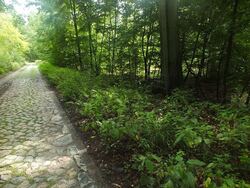
sielisko, podłoże, sposób wzrostu: pobocze drogi brukowanej w żyznej buczynie, na ziemi, kilkanaście owocników;
leg. det. Grazyna Domian; eksykat: tak; uwagi: fot.1472937 fot.1472938 fot.1472939 fot.1472940 [notatka: tak] [fotografie: tak];
1472937
1472938
1472939
1472940
ta strona być może używa ciasteczek (cookies), korzystając z niej akceptujesz ich użycie — więcej informacji