
Amanita verna (Bull.: Fr.) Lamark
owocnik (Fruitbody)
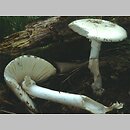
Blaszki białe, szerokie, wolne; ostrza gładkie lub drobno kłaczkowate.
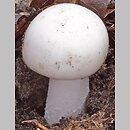
Trzon biały; 70-100(120) × 10-15 mm, równogruby, nieco zwężający się ku górze, pełny, z wiekiem pusty; powierzchnia powyżej pierścienia gładka, poniżej z drobnymi, przylegającymi kłaczkami; pierścień błoniasty, biały, delikatny, często rozerwany; podstawa trzonu bulwiasta i otoczona błoniastą, workowatą pochwą, barwy białej, z wiekiem żółknącą.
Miąższ biały, w kapeluszu cienki; zapach słaby i raczej nieprzyjemny; smak łagodny, orzechowy; z KOH niezmienny; u ciepłolubnego, południowoeuropejskiego gatunku Amanita decipiens z KOH reaguje pomarańczowożółto.
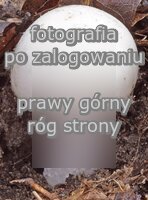
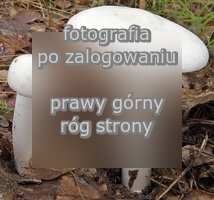
Pileus white to cream-coloured (particularly with age and in the centre); (40)60-80(110) mm in diameter, initially ovoid to hemispherical, with age convex to flat; surface slightly radially fibrillose or smooth, dull, subviscid when wet, seldom with adhering patchy remnants of the veil; margin acute, smooth.
Lamellae white, broad, free; edges smooth or finely floccose.
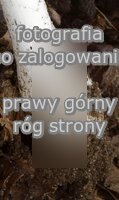
Stipe white; 70-100(120) × 10-15 mm, equal, slightly tapering towards the apex, solid, with age hollow; surface above the ring smooth, below with tiny, adpressed flocci; the ring membranous, white, delicate, often torn; base stipe bulbous and surrounded by membranous, baggy volva, white-coloured, with age yellowing.
Flesh white, in pileus thin; smell weak and rather unpleasant; taste mild, nutty; with KOH unchanging; in thermophilic south European Amanita decipiens reacts with KOH orange-yellow.
zarodniki (Spores)
Spore print white. Spores subglobose to broadly ellipsoid, smooth, 9-11 × 7-9 µm.
występowanie
Rare, prefers warm localities in mediterrane region. Spring, in hardwood forests, usually under Quercus, on neutral or calcareous soils.
wartość (Importance)
Deadly poisonous as Death Cap (Amanita phalloides).
uwagi (Remarks)
![]() |
| A. phalloides var. alba |
![]() |
| A. virosa |
Zobacz stronę porównującą podobne białe muchomory.
From similar Death Cap (Amanita phalloides) differs in smaller size, white colour and surface of the cap and stipe without innate fibrils. Similar white Death (Destroying) Angel (Amanita virosa) has ± conic-campanulate cap and stipe with large floccose squamules, the margin of the cap is often irregular. Amanita verna is the probable cause of fatal mistakes with Agaricus - the latter lacks a bulbous base with volva, its gills with age become brown and spore print in Agaricus is dark brown. See page comparing similar white Amanita.
· Hagara, L., Antonin, V., Baier, J., 1999 — Houby. [49]
· Breitenbach J., Kraenzlin F., 1995 — Fungi of Switzerland 4 - Agarics 2nd part [26IV]
· Galli, R., 2001 — Le Amanite. [78]
· Svrcek, M.; Vancura, B., 1987 — Grzyby środkowej Europy. [25]
· baza „publikacje po 2000 r.”
w Internecie · direct links — lista 2 linków zewnętrznych, w tym miejscu, dostępna w Pełnej Wersji - przejdź teraz
list of 2 external links available in Full Version - use now
wersja publikacji 15.01.2012.www · ostatnio zmieniana/last modified 16.11.2009 · została utworzona/was created 25.01.2003
kod html: <a href="http://www.grzyby.pl/gatunki/Amanita_verna.htm">muchomor wiosenny - Amanita verna - Amanita phalloides var. verna - Grzyby Polski, Fungi of Poland grzyby.pl</a>
BBCode na wielu forach: [url=http://www.grzyby.pl/gatunki/Amanita_verna.htm]muchomor wiosenny - Amanita verna - Amanita phalloides var. verna - Grzyby Polski, Fungi of Poland grzyby.pl[/url]